For years, golfers have been told to “hit down to make the ball go up”, as the way to get the ball up in the air consistently. This bit of advice could be the most misunderstood and damaging thing to golfers and their swings. Just how much should a golfer “hit down”?
Below is a chart of PGA and LPGA Tour averages for some of their club performance data. I refer many average players, both male and female, to the LPGA charts, as clubhead speeds are more similar. The stronger male players may go to the PGA Tour charts.
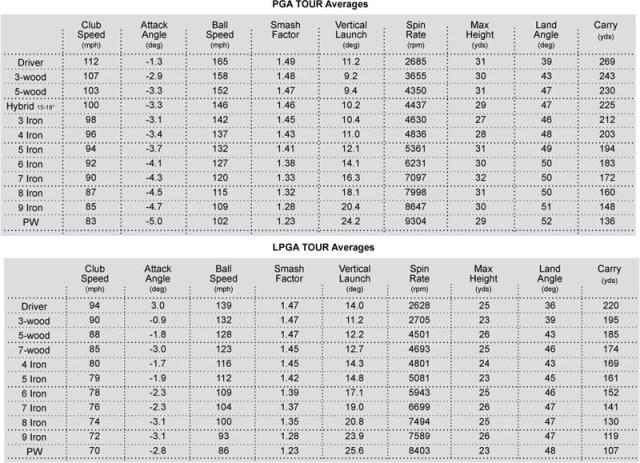
The column we are going to focus on is the Attack Angle. Attack Angle is basically how your club is traveling thru impact. The club can be swinging up, away from the ground; down, toward the ground; or level with the ground thru impact. Take the average LPGA Tour player’s 8 iron shot. The average is 3 degrees down at impact. Granted, there may be some that swing down 5 degrees, and some that swing down 1 degree. The point to see here is that 3 degrees isn’t much at all. When you include the downward swing of the club, and gravity, and the fact that their hands are actually traveling upward at impact, the tour players are swinging pretty level when they hit the golf ball.
When I measure golfers during lessons using FlightScope, the range for the AA is truly all over the charts. Even low digit handicap players can be inconsistent in their numbers. It’s not uncommon for me to see downward strikes of 10-12 degrees, and upward strikes of 4-6 degrees, from all levels of golfers. But when these same players struggle, it can throw off swing paths, dynamic lofts, spin rates, distance, etc. These are the types of little things that golfers couldn’t figure out years ago that now we can often fix in a short amount of time.
One last bit of advice: Don’t pay a whole lot of attention to your divot. You can have an upward AA and make a divot, and a downward AA and not make a divot. My students know I like to see some grass and dirt moved, but that’s no indication of a good or bad AA.
 Bruce Dowell Golf Instruction