Golf IS a Ladies Sport

For Ladies Golf Month, this post is dedicated to the ladies of ALL skill levels. Even if you have played for years, or have never played, there will be points here that will help your game or the way you go about some things. Whether you’re 7 or 70 years old, golf should ALWAYS be fun, and we should feel like we can still play better.

TAKE LESSONS FROM A GOLF PROFESSIONAL: Most ladies and girls start out the game with the help of their husband or father. While all mean well, they are not qualified to teach the game of golf. If you’ve heard the phrases “keep your head down”, “keep your left arm straight”, “keep your eye on the ball”, then you’re getting instruction that doesn’t help. Even if you’re keeping your head down long enough to see the grass grow, it doesn’t mean you’ll hit a good shot. You’ve invested money in clubs, greens fee/memberships, shoes, etc, so learn to things the right way. Good instructors have all the necessary video, monitors, swing trainers, etc to help YOU improve YOUR game.

YOUR EQUIPMENT MATTERS: You don’t have to spend thousands of dollars on your golf equipment. But you do need to have the RIGHT equipment that fits you. Length, weight, lie angle, shaft flex, etc all make a difference. One of my lady students started out like many golfers: She bought a used set from a friend at a good price. The lady who sold the set was about 5 feet tall; the new golfer that bought them was about 5 feet 6 inches tall. The new golfer figures she can learn to hit them, and she did. But the clubs made her set up in a way that she couldn’t swing efficiently, losing distance and accuracy. Again, a Golf Instructor will help you make sure you get the right clubs that fit your budget.

PRACTICE: Many ladies are intimidated about going to the driving range, and it’s understandable. But if you want to play better golf, you need to practice. Go to the very ends of the driving range teeing areas. On one end, everyone will have their backs to you, so they won’t see you. On the other end, your back is to them, so you won’t notice if anyone is watching. Chances are, nobody is paying attention to what you’re doing. They’re too busy trying to keep their head down!

PLAY REAL GOLF: Playing in scrambles is fun and can help you meet new people. However, scrambles don’t make you a better player. In a scramble, if you hit a bad shot, you usually don’t have to play it. Many of my lady golfers play mostly in couples scrambles and fundraisers. In these formats, the ladies don’t learn how to get out of trouble by themselves. The opportunities to hit bunker shots, sidehill lies, out of the rough, etc are much less. But when the lady goes out to play a random round with friends and they play their own ball, they’re not ready for the pitfalls of golf. Play real golf at least as much as you do scrambles.

HAVE FUN AND RELAX: If you’ve done all the things listed above, golf will be easier and more fun. There will always be good shots and bad shots. The more lessons and practice you’ve had, the more you know about YOUR game and tendencies, and how to fix things when your swing isn’t working on the golf course.

Why Your Daughter Should Play Golf

Over the last decade or so, there has been one area of golf that has grown by leaps and bounds: the participation of girls. There are several reasons why your daughter, or a young lady you know, should be considering golf.

daughtergolfWhen I first started teaching golf 20 years ago, there were not many young ladies that went to the course, and the few that did, didn’t take lessons. Girls that played sports typically stuck with the popular sports like softball, basketball, and tennis. As title IX came more prominent, along with more courses being built and an explosion of golf on television, girl participation began to grow. Here are some of the reasons golf is so popular among girls.
Golf is an Individual Sport. This is true most of the time, as many High Schools and Colleges have teams. Players play their own game, and don’t have to worry about remembering X’s and O’s like players in other team sports.

Golf is a Game of Score. Most players that are the best in team sports are bigger, taller, faster, etc. In golf, size doesn’t matter. There is no defense being played in golf, either. There are players who hit it farther, shorter, or have different styles of play. But in the end, all that matters is the score.

Coaching/Parenting Styles Are Different. Many girls I teach have been coached in other sports by coaches who are screaming at some point during practice and games to get their points across. As you can imagine, some of these girls don’t respond well to aggressive coaching styles. On the golf course, the player is their own coach most of the time. When they are with their coach, they’re talking in normal tones in a relaxed manner. I would say just about every girl that has played team sports and switched to golf has relaxed and had more fun. Also, there are no parents offering advice and yelling from the stands or sidelines.

Girls Scholarships Are Available. Hundreds (yes, HUNDREDS) of scholarships go unused every year. Many schools bring in players from overseas to fill roster spots, or even go with a less than full roster, because girls in the U.S. aren’t going after the scholarships themselves. When I’m helping girls in their college searches, I check scores of the schools they are considering. I’ve seen girl’s scores that were in the 140+ range for 18 holes competing in college events. These girls are getting good $$ to play. I recently had a college coach call me, (Division I, GREAT school) looking for a decent player, and tell me he could not find a girl to play golf and was having a Volleyball team member fill in at tournaments.

Golf Is the Game of a Lifetime. Golf is the one sport your daughter can play the rest of her life. Softball, basketball, track, etc all have short careers. It’s something that she can do with her friends, spouse or her own children years down the road.

Golf Is a Low-Injury Sport. Golf is a non-contact sport. While there may be aches and pains, golf is relatively easy on the body compared to other sports. If your girl does play golf, invest in a good pull or push-cart to take the stress of a bag off her back and shoulders.

If your daughter has had issues with other sports, or their coaches, I suggest looking into participating in golf. Many girls are pushed towards the other sports because of the past involvement of family or their friends. Introduce yours to the game of golf. You’ll be glad you did.


Radar vs. Video

As the age of video for golf instruction comes to a close, it’s an exciting time to be a golf instructor. While video will always have its place and time during a golf lesson, the new technology takes all the guesswork out of what is happening during the golf swing.

For years, instructors taught by either watching a golf swing on video, or watching a student’s patterns of golf shots. Many of us taught by studying the ball-flight tendencies produced by the golfer, and worked to make the necessary changes to improve them. Other teachers would build a player’s golf swing by modeling it after a Tour-caliber player on video or in pictures.

Obviously, a lot of success was had doing it both ways. The Tour players in the old days didn’t have the benefit of video, so they worked on their ball flights and the swing theories of their time. When hi-speed cameras came along, it was easy to break down swings frame by frame and try to copy what top players did. The problem for a lot of players was that they didn’t know what they were seeing, and what was causing it, and they would hit inconsistent and frustrating shots. Now, with the advances in technology, numbers and fixes are at our fingertips immediately.

Through the years, we’ve seen “beautiful” swings like Snead, Hogan, Woods, and Scott. We’ve also seen swings that we would never try to teach or copy, like Furyk, Trevino, and Daly. The latter players worked on “functional” swings that produced repeatable shots. They were fortunate to find the combination of swing components that affected their ball flight without a “perfect” swing.

I see players standing on the range, recording their swings and studying them intently, and I wonder sometimes what they are looking for. It’s usually a point in the backswing, or at the top of their swing, or at some point in the downswing. Very rarely is it at the moment of impact. They can’t measure impact on their phone. Successful impact is a combination of a lot of things. For a great shot, the combination of things that have to go into it include, none of which are visible on video:

Swing path
Clubface Angle
Sweet Spot Impact
Angle of Attack
Swing Speed
Ball Speed
Dynamic Loft
Spin Loft

The old saying “the camera never lies” isn’t true in golf. What is visible in video are certain body movements and certain club positions. The true components for a golf club working properly are measurable in the TrackMan and FlightScope monitor, which I use. Why would you guess, when we can measure it to the degree?

For more information, I suggest you watch James Leitz’s “Video vs. Radar” on the Trackman website by clicking the link below.

James Leitz – Video vs. Radar


Learn Your Angle of Attack

For years, golfers have been told to “hit down to make the ball go up”, as the way to get the ball up in the air consistently. This bit of advice could be the most misunderstood and damaging thing to golfers and their swings. Just how much should a golfer “hit down”?

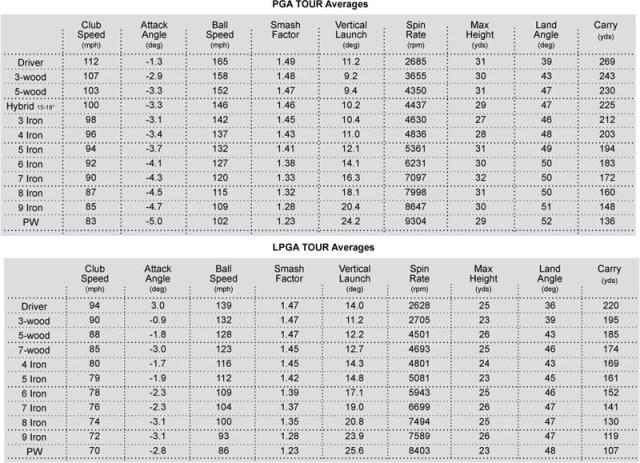
Below is a chart of PGA and LPGA Tour averages for some of their club performance data. I refer many average players, both male and female, to the LPGA charts, as clubhead speeds are more similar. The stronger male players may go to the PGA Tour charts.

tmmi

The column we are going to focus on is the Attack Angle. Attack Angle is basically how your club is traveling thru impact. The club can be swinging up, away from the ground; down, toward the ground; or level with the ground thru impact. Take the average LPGA Tour player’s 8 iron shot. The average is 3 degrees down at impact. Granted, there may be some that swing down 5 degrees, and some that swing down 1 degree. The point to see here is that 3 degrees isn’t much at all. When you include the downward swing of the club, and gravity, and the fact that their hands are actually traveling upward at impact, the tour players are swinging pretty level when they hit the golf ball.

When I measure golfers during lessons using FlightScope, the range for the AA is truly all over the charts. Even low digit handicap players can be inconsistent in their numbers. It’s not uncommon for me to see downward strikes of 10-12 degrees, and upward strikes of 4-6 degrees, from all levels of golfers. But when these same players struggle, it can throw off swing paths, dynamic lofts, spin rates, distance, etc. These are the types of little things that golfers couldn’t figure out years ago that now we can often fix in a short amount of time.

One last bit of advice: Don’t pay a whole lot of attention to your divot. You can have an upward AA and make a divot, and a downward AA and not make a divot. My students know I like to see some grass and dirt moved, but that’s no indication of a good or bad AA.

Get Your Shots to the Flag!

I give quite a few playing lessons to my students, and I can’t remember the last time one of them hit a ball over the back of a green. However, I do see them miss the green short with a solid shot, probably as much as they miss it left or right.

Many golfers really have no idea how far they hit each shot, but they let their ego tell them how far they hit each club. Golfers have a tendency to remember their best shot and how far it went. Think back to the times you’ve played your home golf course this year. How many times did you hit a ball over the green, with a solidly struck shot?

Many of my new students are aware of how many greens they hit in regulation during a round of golf. What I ask for is that number, plus how many shots are within 5 yards of pin-high. Those shots are the ones that will affect golf scores in positive ways, assuming the shot is online, as a putt inside of 15-20 feet is often a fairly makeable putt.

Let’s say you’re playing to a green that is 30 yards deep (90 feet). The pin is 18 feet from the back edge of the green. You hit a solid shot about 15 feet onto the front part of the green, on line with the pin. Most golfers are happy about the prospect of hitting the green, having a birdie putt, etc. In reality, they’ve left themselves a putt of about 55-60 feet, which isn’t exactly in the range of a makeable putt. Golfers don’t practice 60 foot putts very often, so the result is often a 3 putt, and the golfer will beat himself up mentally over a missed putt.

The biggest problem with this scenario is, the golfer didn’t hit the proper club to give himself a reasonable birdie putt to begin with. The first putt was approximately 60 feet away, or 20 yards difference. Twenty yards is often TWO club’s difference in distance (the gapping between iron distances is about 10 yards for many players.) Assume this golfer had 150 yards to the pin, and he hit his approach to the green with a 7 iron, and it ended up going 125-130 yards. That’s reality. To get the shot closer, the golfer would have possibly needed to hit a 5 iron to get the ball within that “five yards of pin high” that would have given him a reasonable birdie putt. The ball was on-line, it just didn’t get there close enough for a scoring opportunity.

Most of my students will analyze a round of golf with advanced numbers. We don’t count “just” GIR, fairways hit, number of putts, etc. We are making sure we get the ball in scoring zones. The object of golf is to get the ball to the hole. Make concentrated efforts to get every putt, chip, and iron shot to the right distance.

The Importance of Training During Off-Season

For a lot of golfers, winter means the end of golf season. Shorter days, colder temperatures, and golf course conditions can seem pretty dreary for several months. For many of my students, it’s actually the time we can get the most done.

Here are some reasons why:

  1. Making swing changes can take time. So much depends on the student and the change, it makes them unpredictable. Sometimes it is immediate improvement, or it can take a few days or a couple of weeks. Knowing that it’s hard to make changes during tournament season, I will usually save the biggest changes for the time that’s least stressful, and there is time to practice, worry free. No golfer wants to stand over an important shot with doubts and swing thoughts running through their head.
  1. Golf is one of the hardest things people ever do.  Many people are under the impression that they can put their clubs away in October, start playing again in May, and pick up where their game left off. For the majority of golfers, it doesn’t work that way. It may take a few weeks to get their swing back (if they do at all), get their confidence going, and play their best golf. I see many golfers who are frustrated because they play their best golf close to the end of the season. It’s clearly because of the time they took away from the game. Look at this way: When May rolls around, you’ll feel a lot better about your game if you’ve swung the clubs approximately 12-15 times in 6 months, than if you had not swung them at all.
  1. Golfers that don’t play lose their flexibility, golf muscles, stamina, and confidence. Adults are often sedentary during the winter months, and golf can keep them active and flexible. Seeing improvement is always good for the mind.
  1. Junior golfers should practice and swing as much as possible during the winter. I know there are plenty of sports and school activities that keep them occupied during the offseason, but again, just swinging a few times a month will make a difference. Juniors also can grow taller and stronger during these months, their arms and legs are longer, their eyes farther from the ground, etc. Their golf clubs will certainly feel lighter, and probably shorter. If they keep swinging through those months of growing, they won’t notice things as much. Coming back from 6 months off can have a huge effect on their development. Give the kids every chance to enjoy and be great at golf!

Take advantage of the indoor facilities and ranges that offer places to practice, and play when the weather allows. Give yourself and honest evaluation of your golf game, and let me help you make a plan and goals to improve so that your game is better for next year.

Why You Don’t Play Your Best Golf

Golfers looking for quick fixes and tips usually read the golf magazines or watch television, and unfortunately, there’s a lot of bad info out there. The game of golf has been taught the same way for decades now, and we’ve had a generation of golfers that slice the ball, top the ball, and have a ton of inconsistency. These things lead to frustration and more bad habits, if you don’t address them immediately.  If you want feel like your golf game is not living up to its potential, and you’d like to see longer, straighter shots, let me show you how to achieve those goals.